

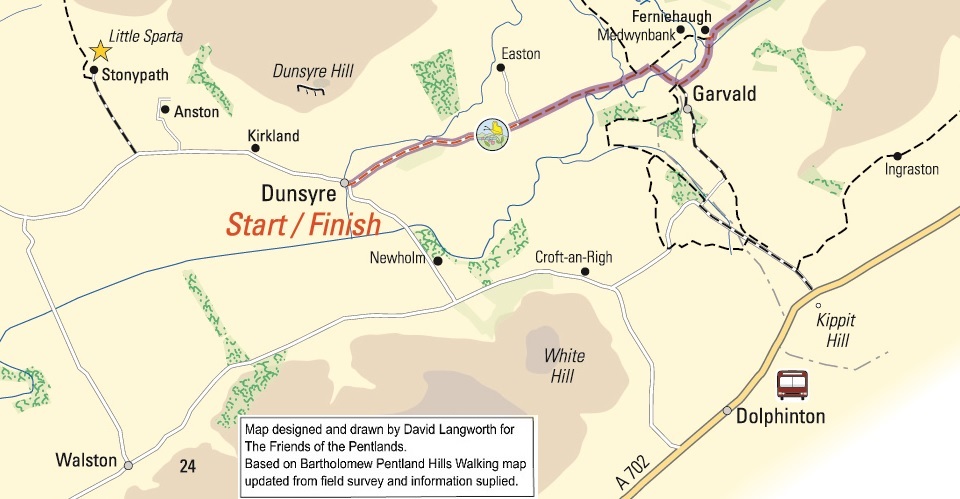
Dunsyre in Gaelic (dùn siar) means the fort of the marsh and western hill fort. Dunsyre Hill (“the hill of the seer”) displays cultivation terraces as early evidence of man’s involvement with the are dating back to prehistoric times and going through to the medieval period – the terraces would have been hewn out with primitive tools on steep ground overlooking the marsh below.
In the 19th century the village was well connected by rail, with the track of the old Caledonian Carstairs-Dolphinton line still visible. The Halt, now a private dwelling, opposite the start of the Pentland Way includes the remains of Dunsyre station.
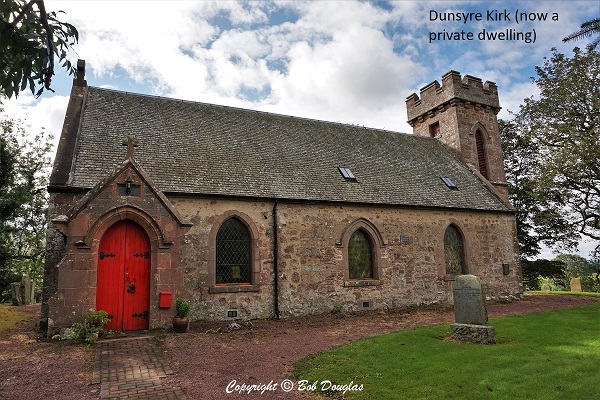 For centuries Dunsyre was a religious centre and some claim that the present church was built on ground once used for Druid worship The church (with its added Victorian tower) whose narrow entrance is found at the end of a row of cottages in the heart of the village. Although the church building is now a private dwelling, the council-owned graveyard is open to visitors and is well worth a visit with wonderfully inscribed headstones of angels, skulls, cross bones, swords and people, some dating back to the 17th C. On the north side of the church at one end, halfway up, is a glass case enclosing a jougs or iron collar which was fastened to the walls of parish churches or mercat crosses. It was used for religious as well as civil offences to publicly shame offenders and was popularly known as a ”Nags Collar”.
In the late 1100s the church was associated with the monastery at Kelso, founded by Tironesian monks from Chartres, in France, in 1128. By the early 1600s, following the Reformation, the church was strongly Presbyterian and the grave of minister William Somervell, who died in 1646, can be found in the churchyard. The area is strongly associated with the Scottish Covenanters, not least because many conventicles were held in the surrounding hills.
Nearby Places of Interest
At Black Mount Parish Church, formerly known as Dolphinton Church, at NT101464 there is a memorial plaque to Major Joseph Learmont who was the leader of the Covenanters’ troop of horse at the battle of Rullion Green in 1666. He survived their subsequent defeat and was again in the field at the battle of Bothwell Bridge in 1679, but in 1682 he was arrested and sentenced to imprisonment on the Bass Rock. Luckily, he was released following the Glorious Revolution in 1688 and the passing of the Bill of Rights. He died at Newholm in 1693 at the age of eighty-eight and is buried in the graveyard.
The garden of the late Ian Hamilton Finlay (1925-2006) at Little Sparta is unique and well worth a visit, not least because it contrasts so starkly with the surrounding countryside. The garden is at the former farm of Stonypath (NT055488) which Finlay purchased in 1966 and from when he and his wife set out to create what has become an internationally acclaimed garden across seven acres of a wild and exposed moorland site.
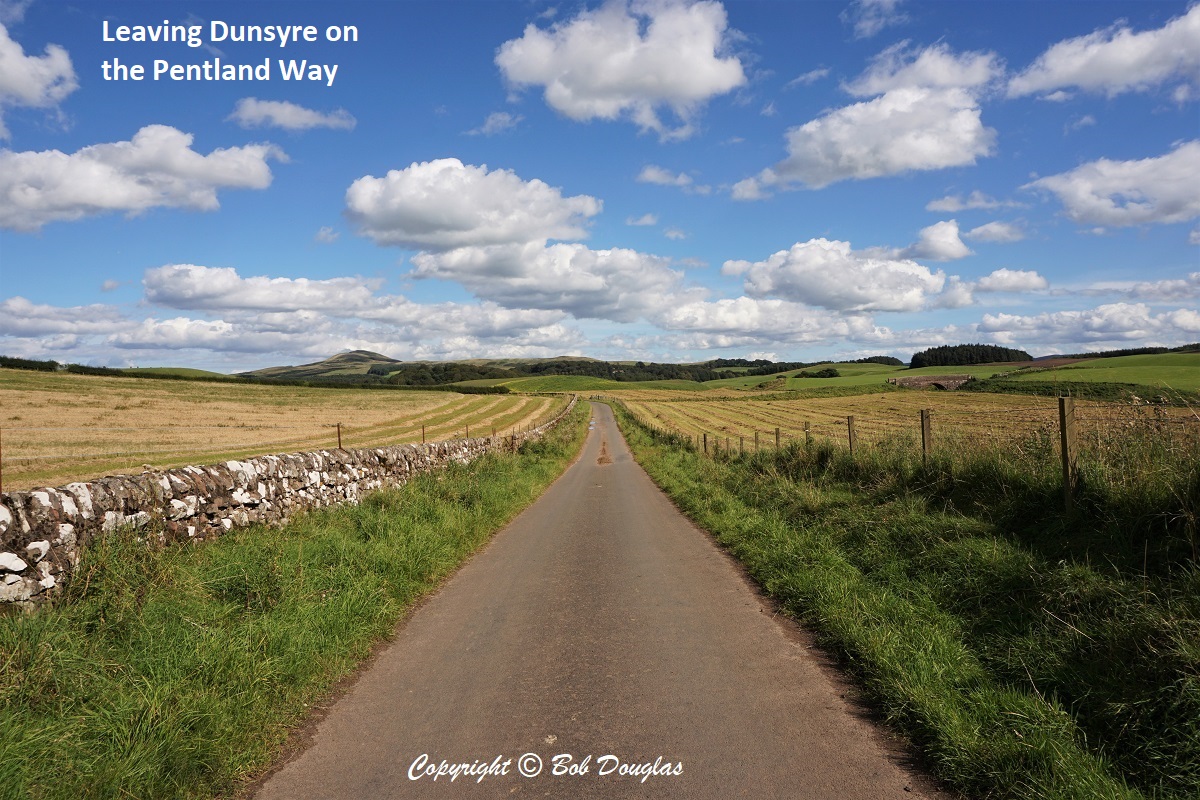
Dunsyre >> Garvald