

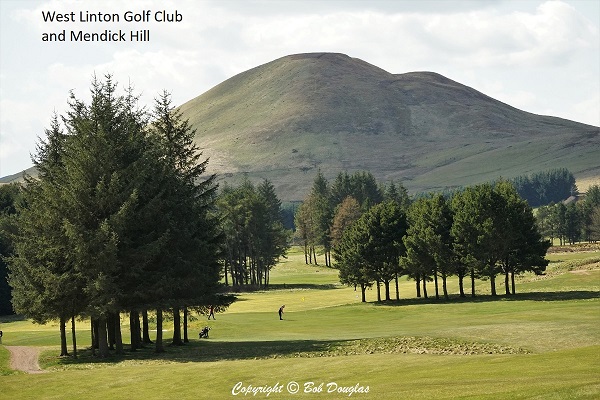
 The Pentland Way does not actually pass through West Linton. It follows the old Roman Road that passes West Linton Golf Club (located to the north-west of the village).
By West Linton Golf Course
 Where the Pentland Way meets the Roman Road there is an attractive spot to relax alongside one of the Friends of the Pentlands’ Arboreta of native Scottish Trees (hyperlink). At this point there is a grassy mound which contains seven re-sited Bronze Age burial cists from West Water Reservoir. There is a good interpretation panel at the site. Some 4,000 years ago bodies were not ‘laid out’ for burial but were buried as they died often in a curled-up position. Three of the cists contained fossil pollen, grains of meadowsweet (filipendula ulmaria), also known as Queen of the Meadow. Meadowsweet has, very occasionally, been found in other Bronze Age burials. In the 16th century it was customary to cover floors with rushes and herbs to give warmth and overcome smells and meadowsweet was the favourite choice of Elizabeth I. West Water reservoir though to the west of the Pentland Way is worth a visit as it is a significant overwintering site for up to 40,000 pink-footed geese.
West Linton
West Linton is a village of ancient origin. In the 17th century it was famous for its fairs and markets. The Linton market was an important destination for the drovers who brought their herds of cattle from Falkirk and Crieff (over the “Thieves Road”). Upwards of 30,000 sheep might be sold annually making it one the largest animal markets in Scotland and from which the expression “as big as a Linton market” derived. In the 18th and 19th centuries weaving gave the township its importance with as many as 30 home looms in the area.
Though off the Pentland Way, the village is worth a visit, with a guide to a tour of its historical features provided by the West Linton and District Historical Association.